The AI-native infusion OS
The infusion OS built natively for both human and AI agents.
Clear the patient. Get the authorization. Book the chair. Restock the drug. Bill the claim. In nico each one is a task. Agents carry most of them and write down what they did and where they read it. People make the few calls that are theirs. Everyone works from the same record.
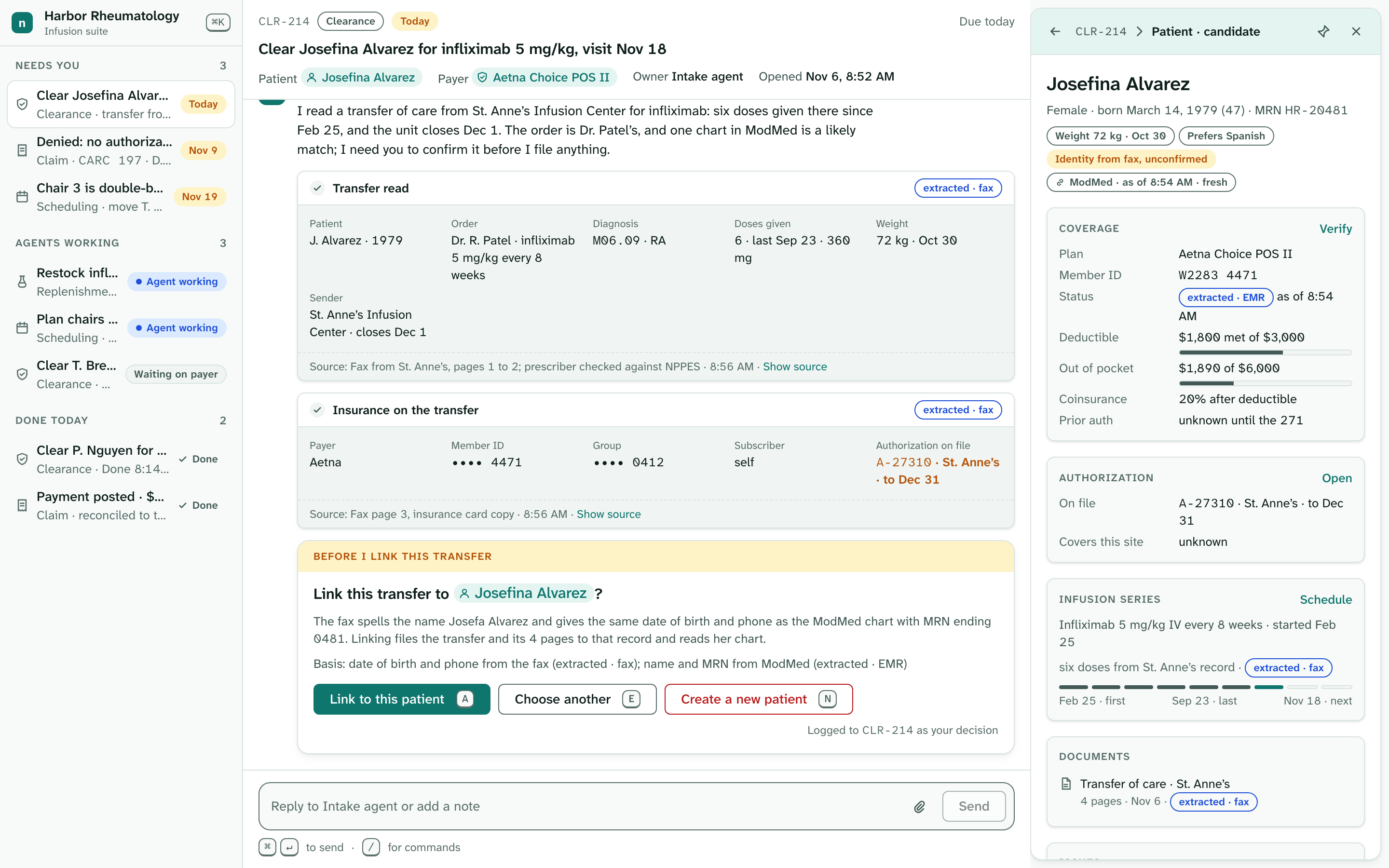
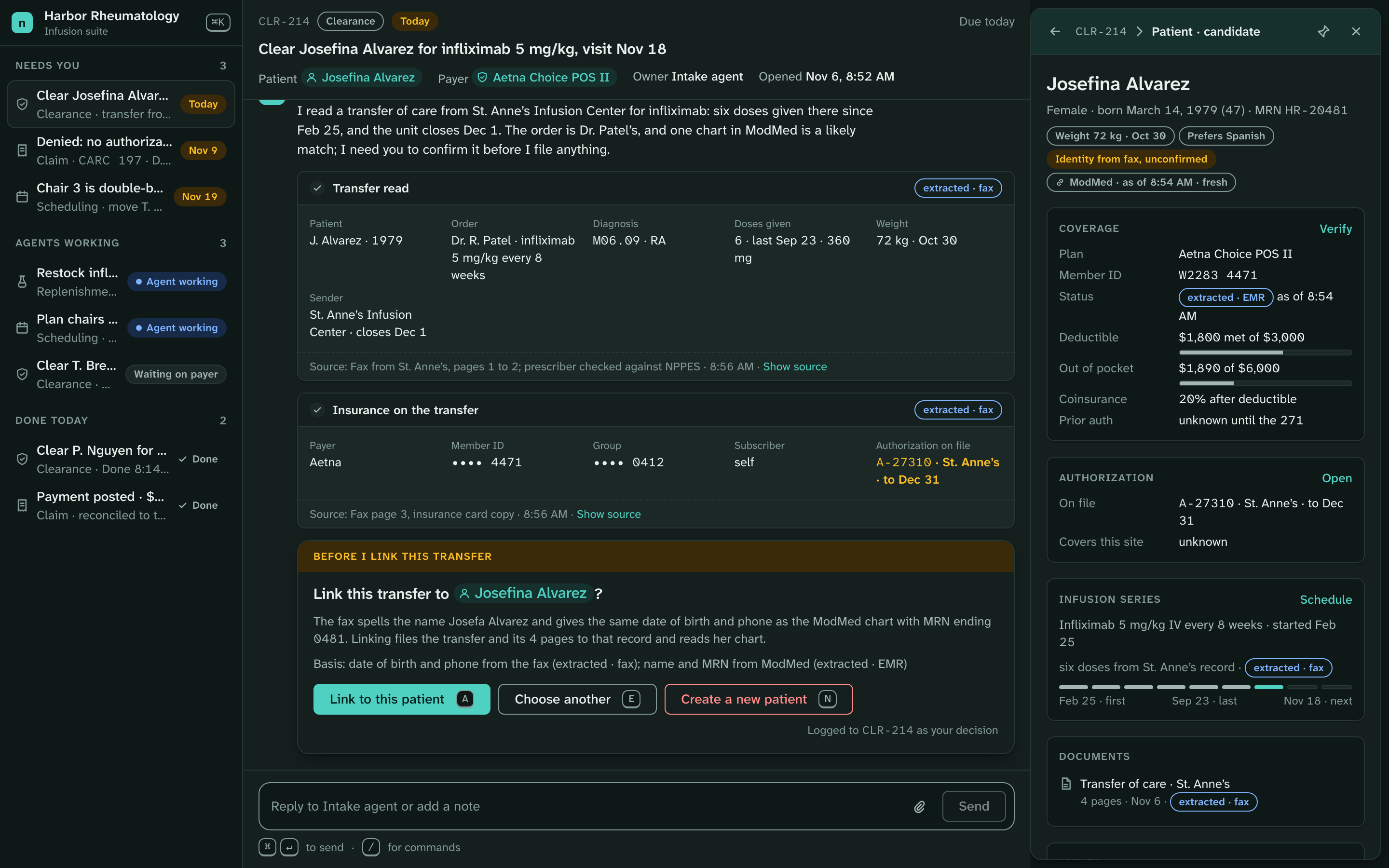
- Everything is a task
- The whole center is tasks, in six kinds and six states. No hundred screens to configure and staff.
- Agents and people, together
- Agents do the legwork: benefits, authorizations, scheduling, the visit record, claims, restocking. People decide what is theirs, in the same task.
- Closes to the money
- It runs through the claim and the remittance, because an infusion suite lives on what it gets paid.
How it works
Six kinds of task carry a patient from referral to remittance.
Four follow the patient, in order: clearance, scheduling, the visit, the claim. Two run alongside: replenishment and setup. Each has an agent that signs its work and a gate where a person decides. Infusion is a series, so before every dose the agents re-verify, re-authorize and re-book on their own.
The patient's path
Running alongside
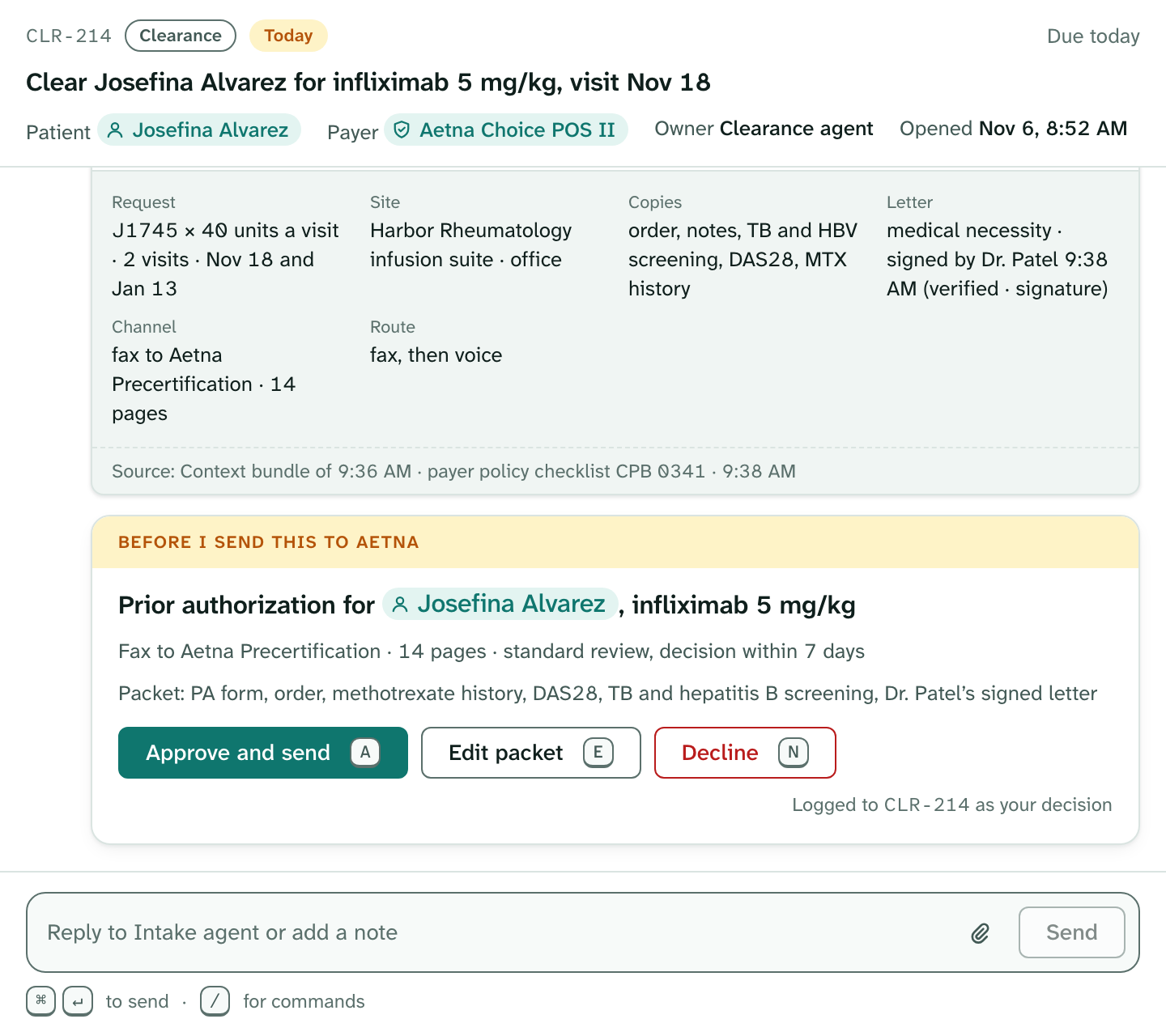
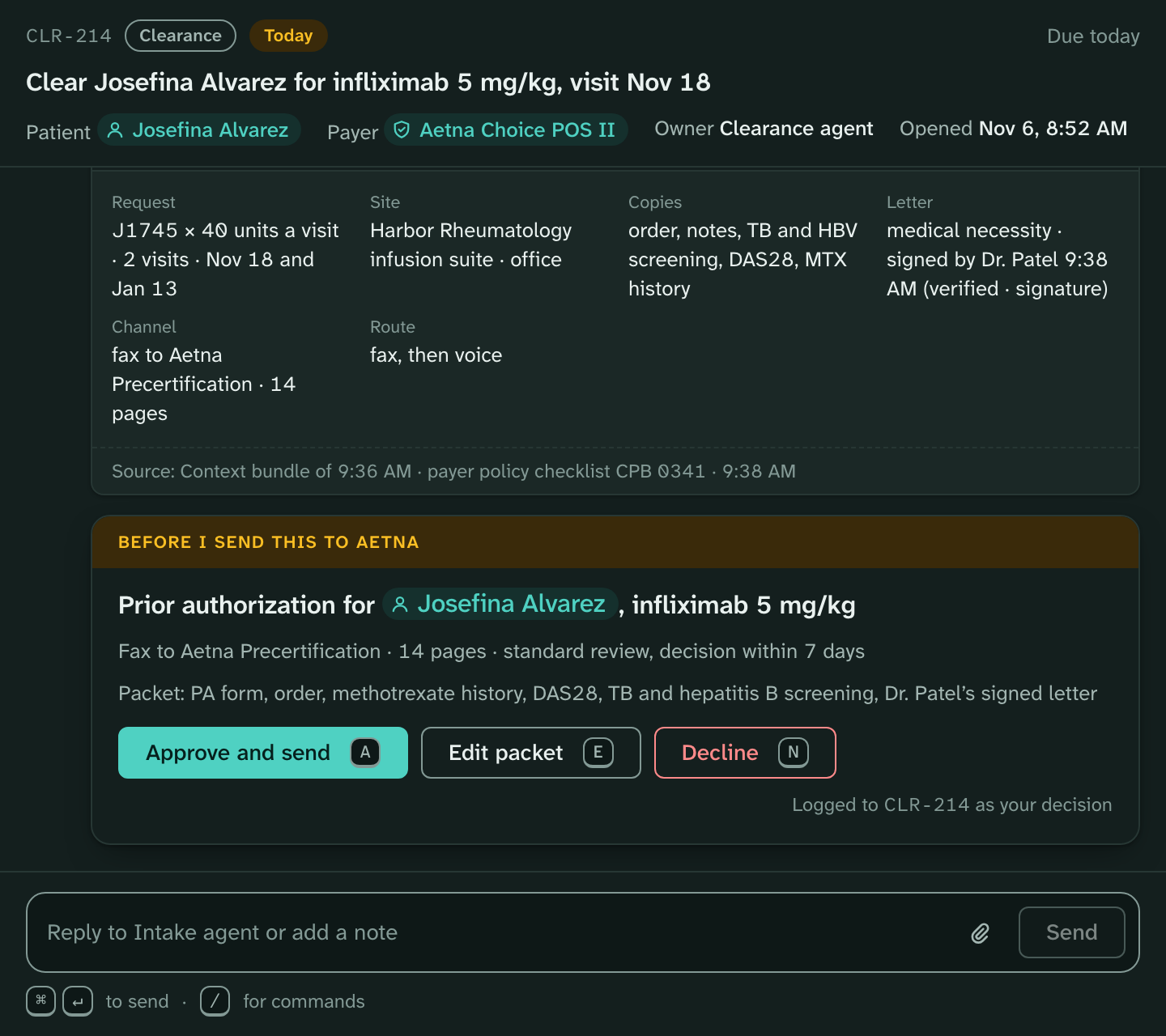
- The agent
- Reads the referral, verifies benefits, estimates the cost and finds assistance. Builds the authorization packet from the payer's checklist, then tracks the payer's clock once it is sent.
- You
- The coordinator approves the packet and the estimate. If the payer denies, the provider decides between an appeal and a change of site, in the same gate.
Seven tasks, one dose, paid in full.
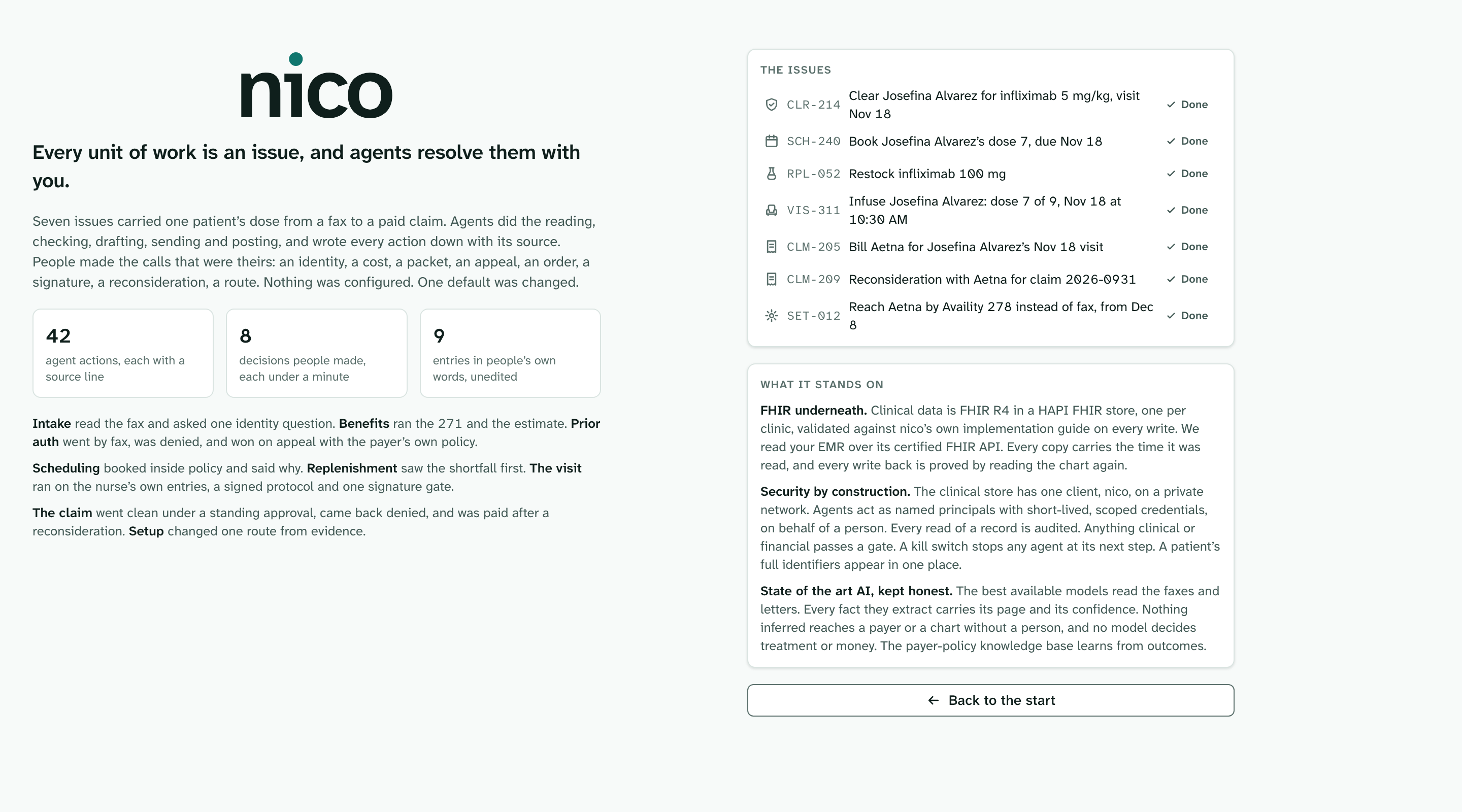
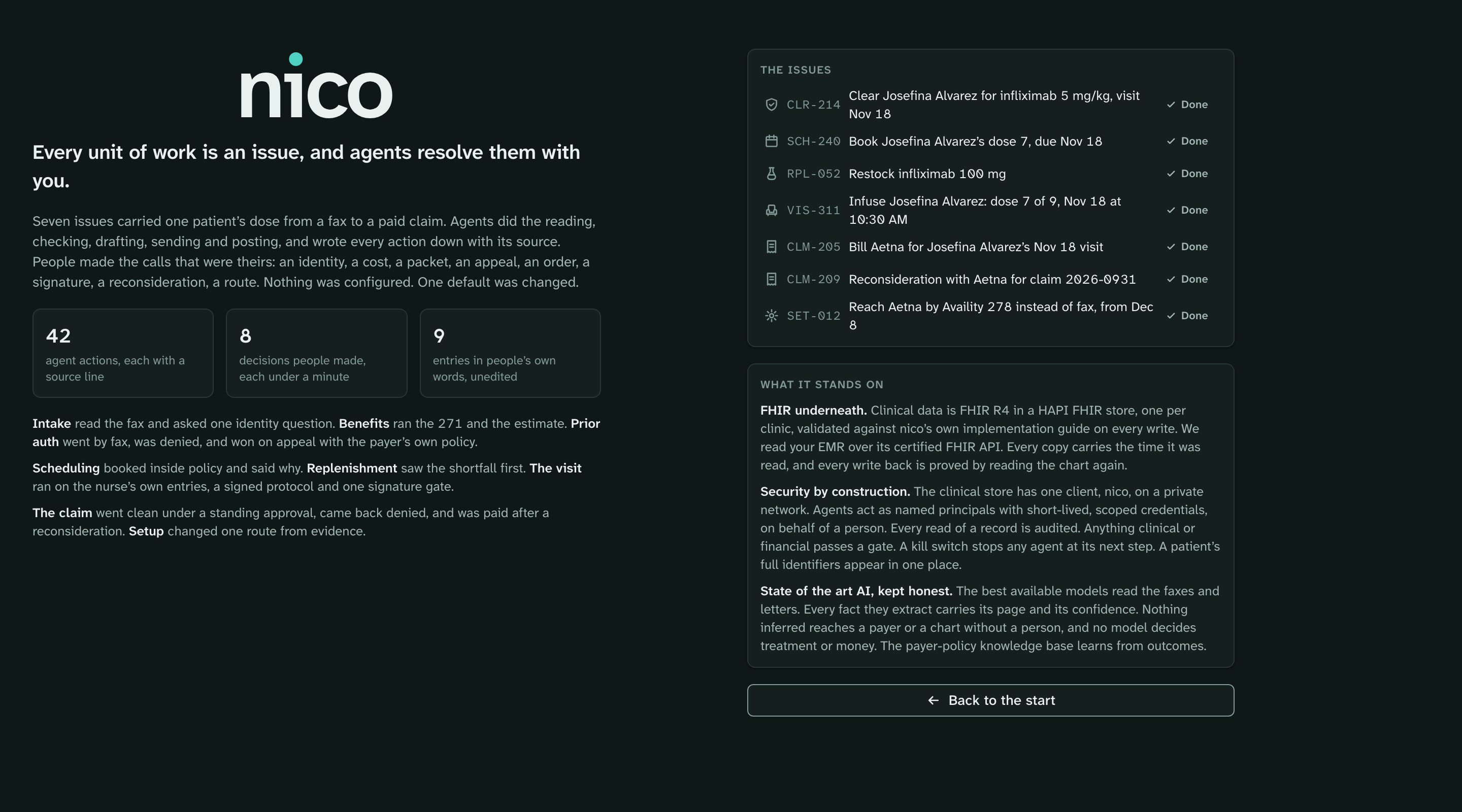
By the end of the walkthrough every task is Done. There are seven, not six, because the denied claim became a second claim task of its own. Agents did the reading, checking, drafting, sending and posting, and wrote each action down with its source. People made the eight calls that were theirs, each in under a minute.
Walkthrough
See how nico works, from referral to remittance.
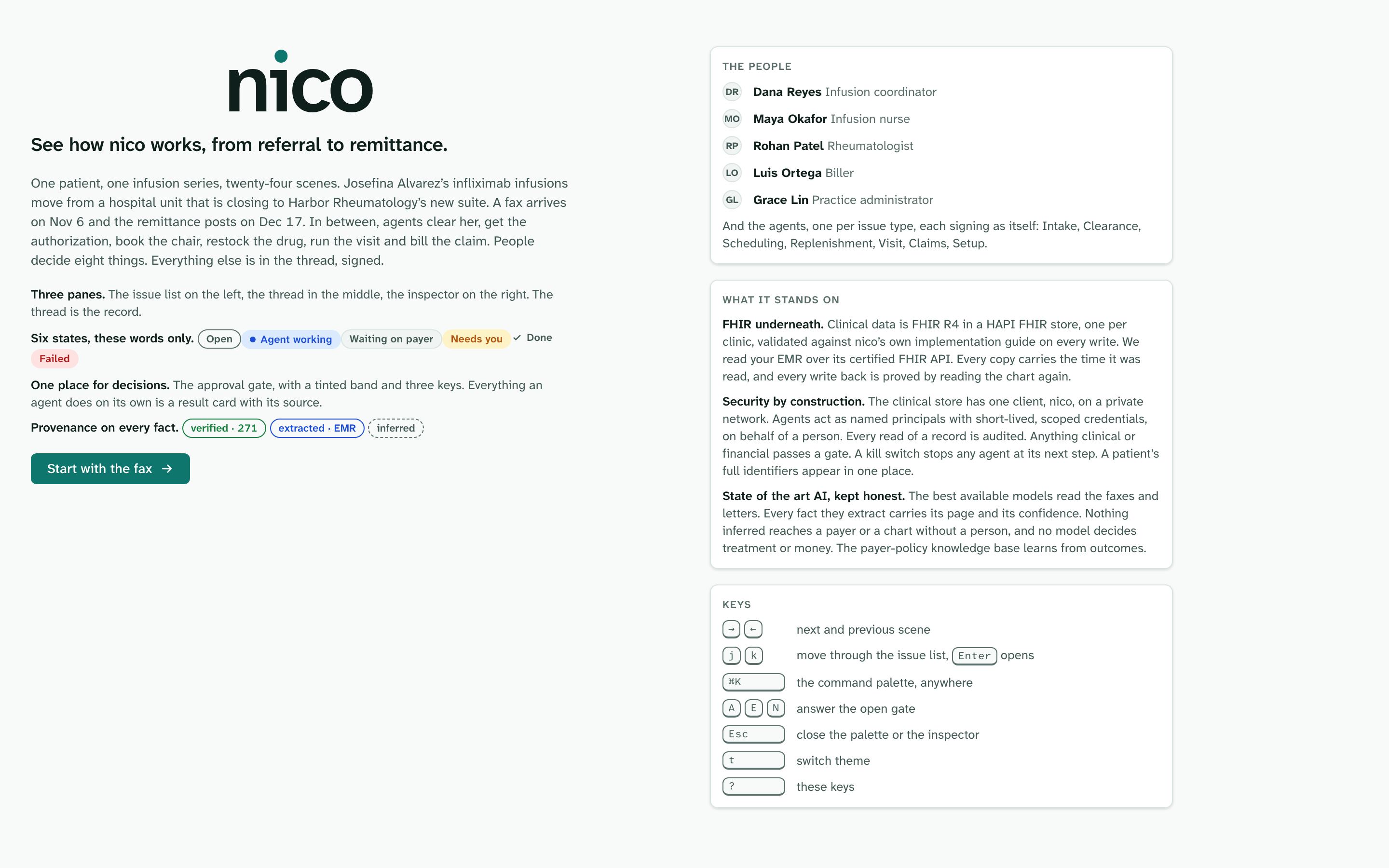
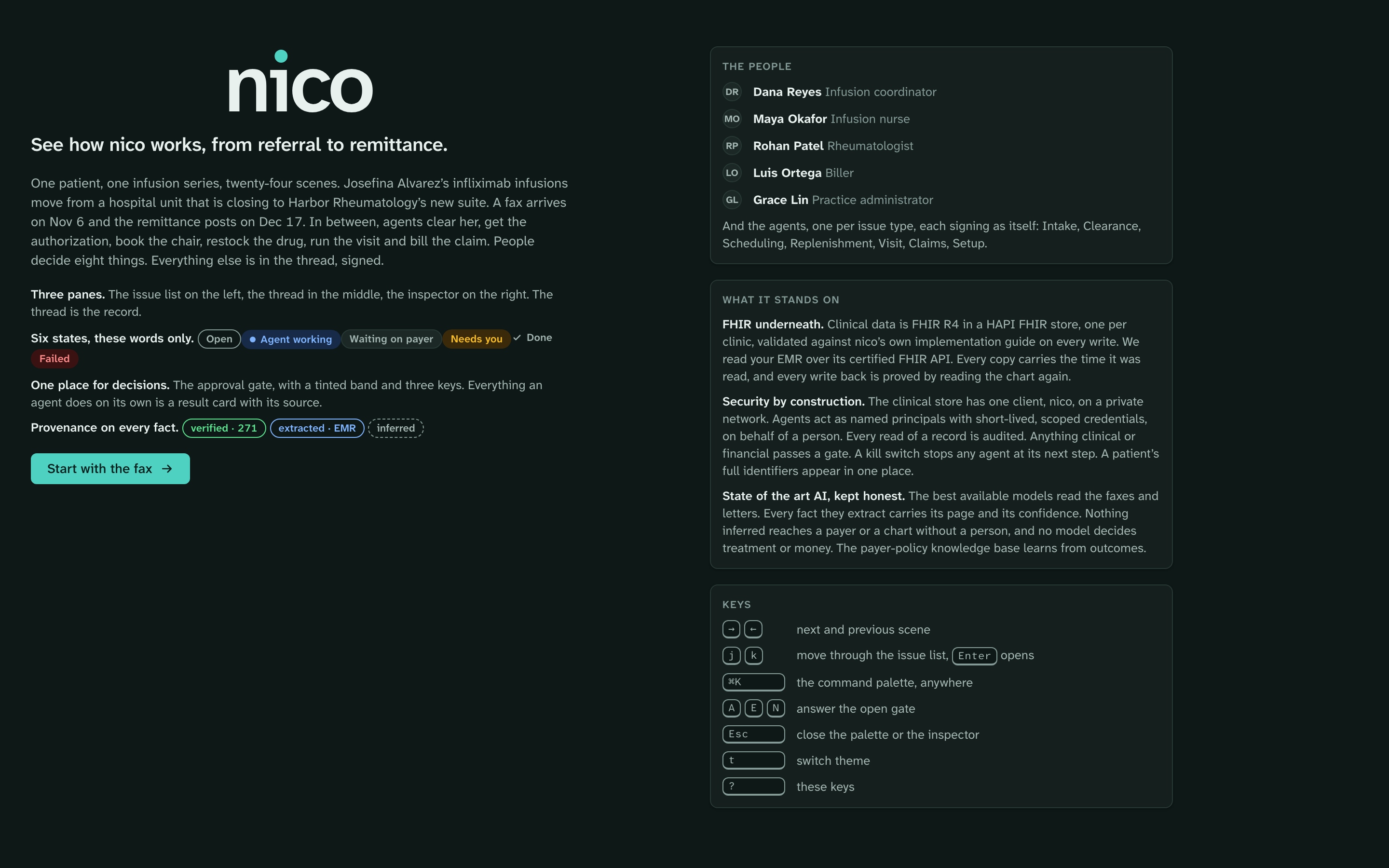
One patient, one infusion series, twenty-four scenes. A fax arrives on Nov 6 and the remittance posts on Dec 17. In between, agents clear her, get the authorization, book the chair, restock the drug, run the visit and bill the claim. People decide eight things. Everything else is in the thread, signed.
The first four scenes are open. Leave an email for the other twenty. The shell behaves like the real one: everything a button does, a key does too.
- →←
- next and previous scene
- jk
- move through the task list, Enter opens
- ⌘K
- the command palette, anywhere
- AEN
- answer the open gate
- t
- switch theme
How it works · Supervision and audit
You supervise. The record keeps itself.
Screens in nico are for supervising agents, catching exceptions and correcting them. Not for typing data in. The thread is the record, and it is what clinical and billing work has to be able to show.
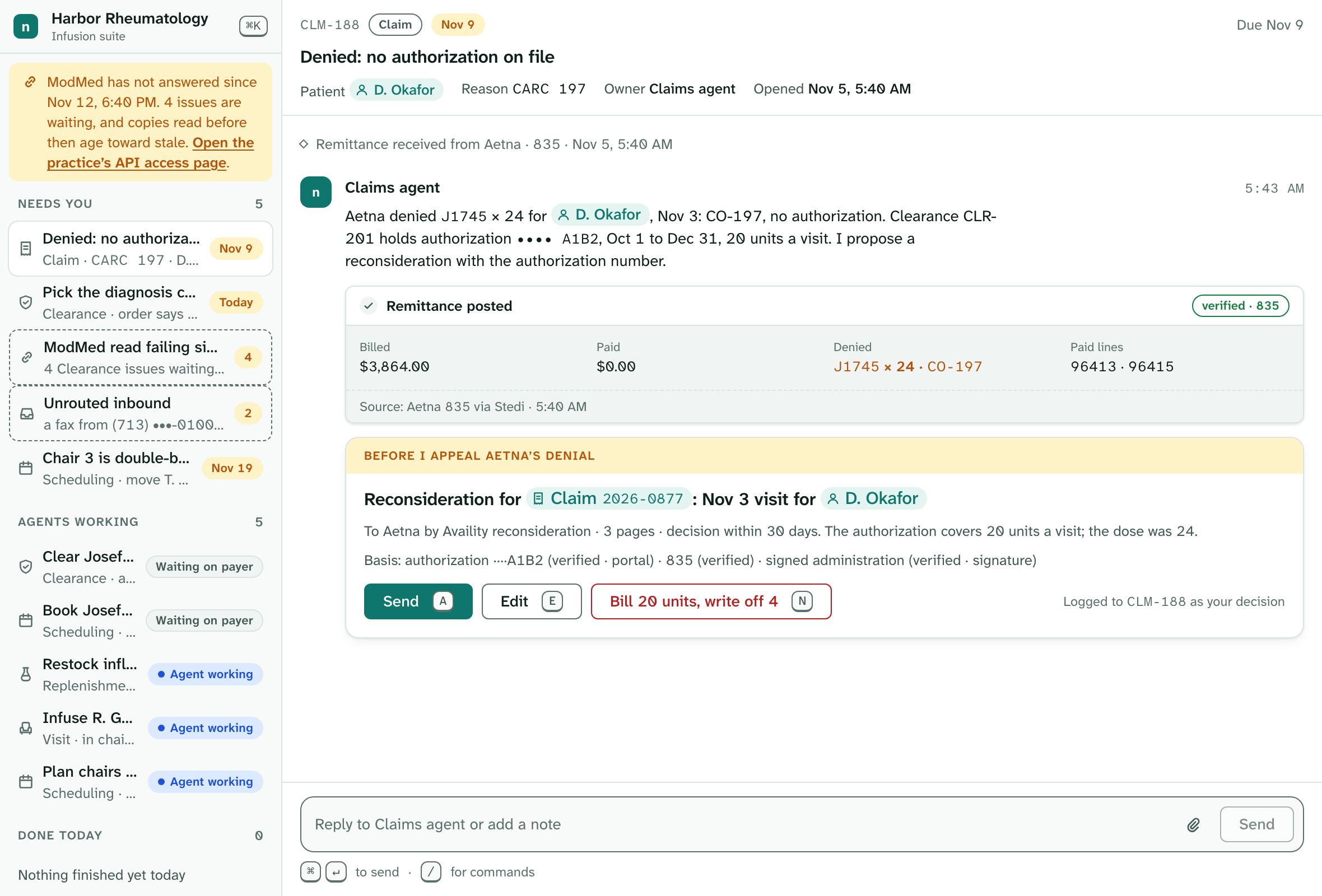
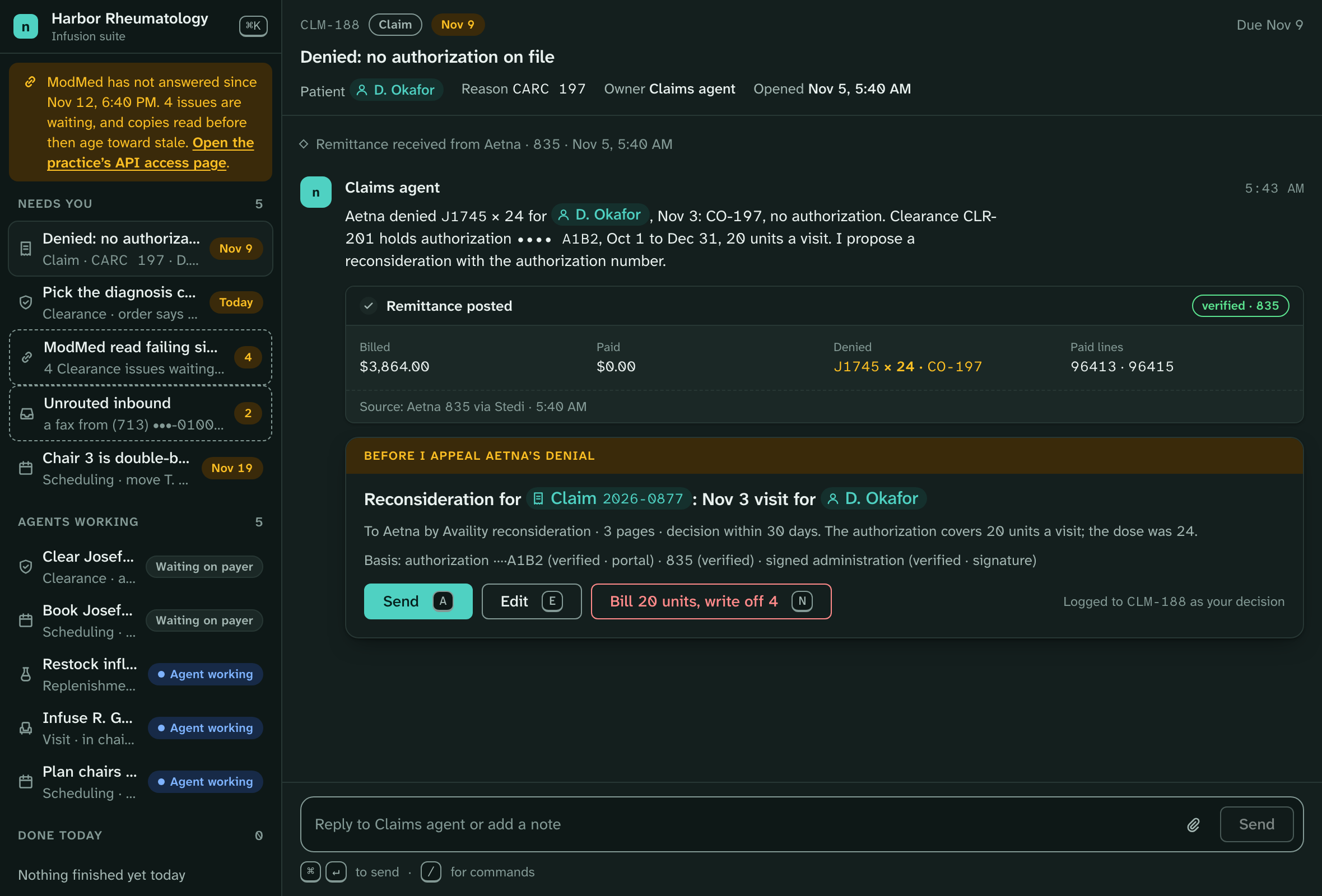
Triage is the day.
Needs you is ordered by who is waiting, then what is due, then what is at stake. j and k move. Enter opens. A answers the gate and moves to the next row. Queues that are not tasks, like unrouted faxes or a connection outage, get one grouped row each.
One place for decisions.
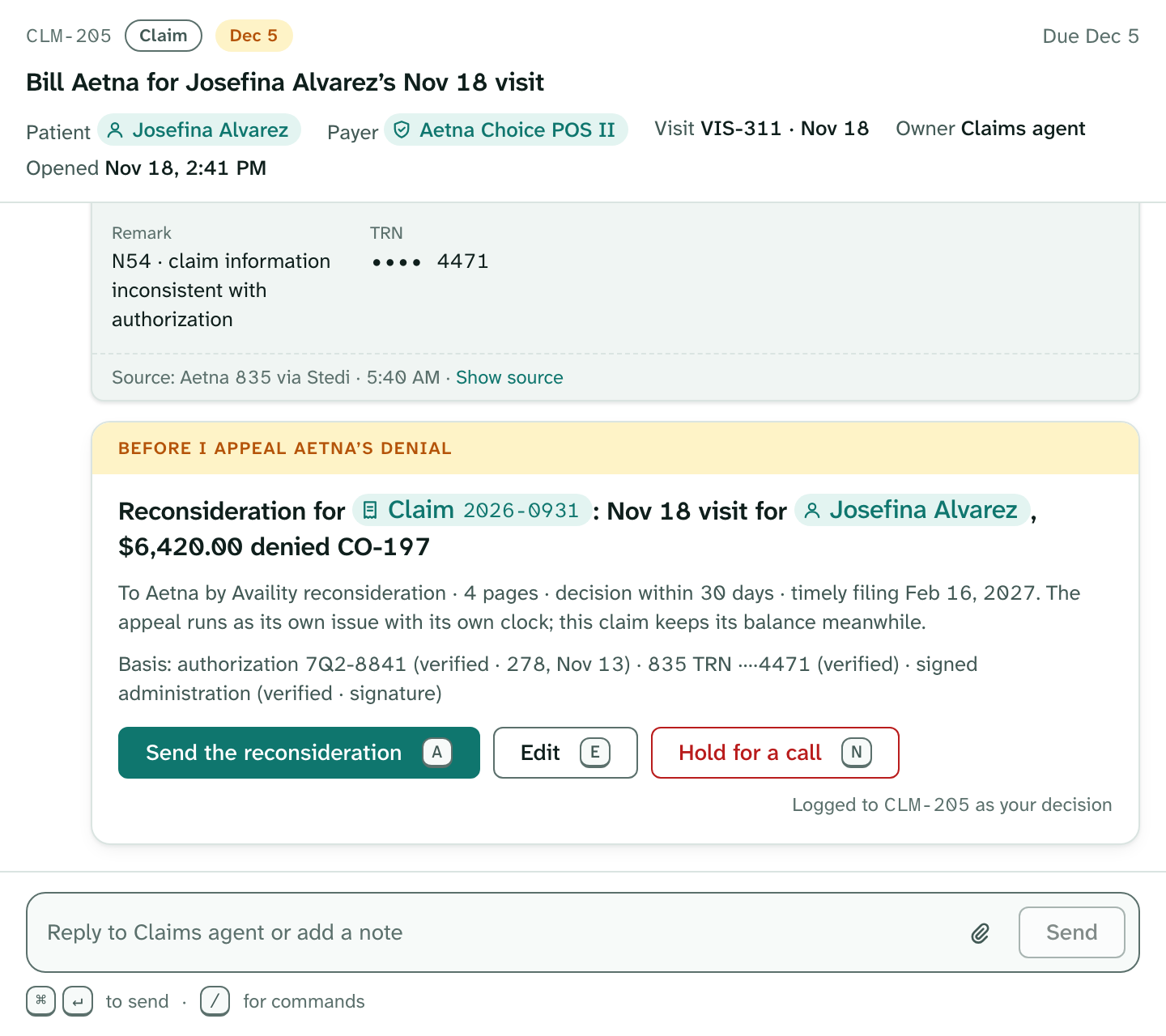
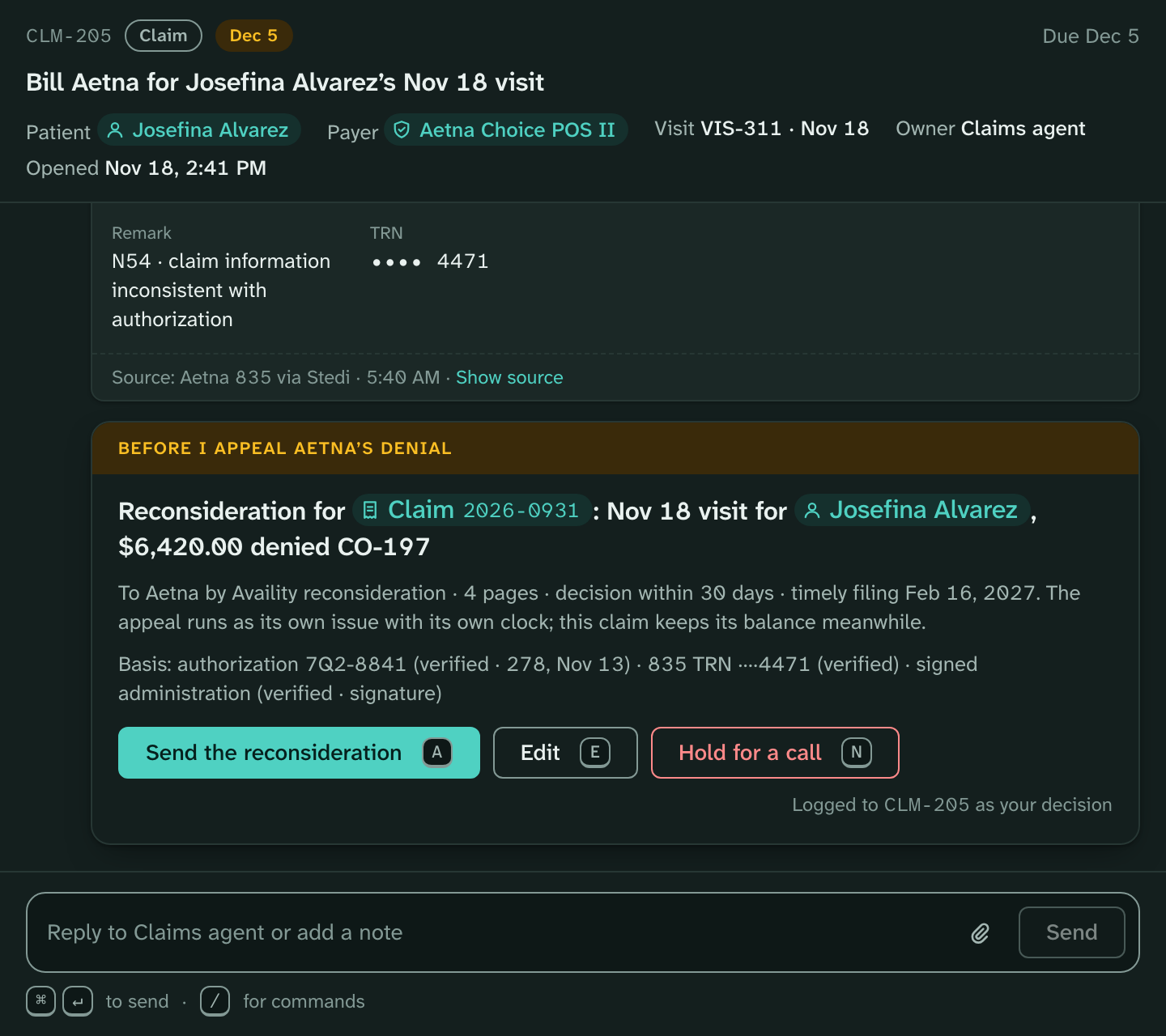
Anything consequential stops at a gate: an identity, a cost, a packet, a signature, a reconsideration, a route. The gate shows its basis, recommends an answer, and takes A, E or N. The decision is logged with who, in what role, and when.
Every entry is signed.
Agents sign as themselves. People write in their own words, unedited. Corrections get appended. Nothing is edited in place. The thread is the audit trail, and a payer could read it.
Provenance on every fact.
A fact from a rail is verified. A fact read out of a document or the chart is extracted. A fact the agent worked out is inferred until a person confirms it. Every tag says its word, never only a color. Done is quiet.
verified · 271extracted · EMRinferred
Standing approvals, scoped.
The one sanctioned way around a gate: a standing approval scoped to a payer, capped, and expiring. Every action under it is logged with its number. A clean claim to a known payer goes out on its own. A denial comes back to a person.
Writeback you can read back.
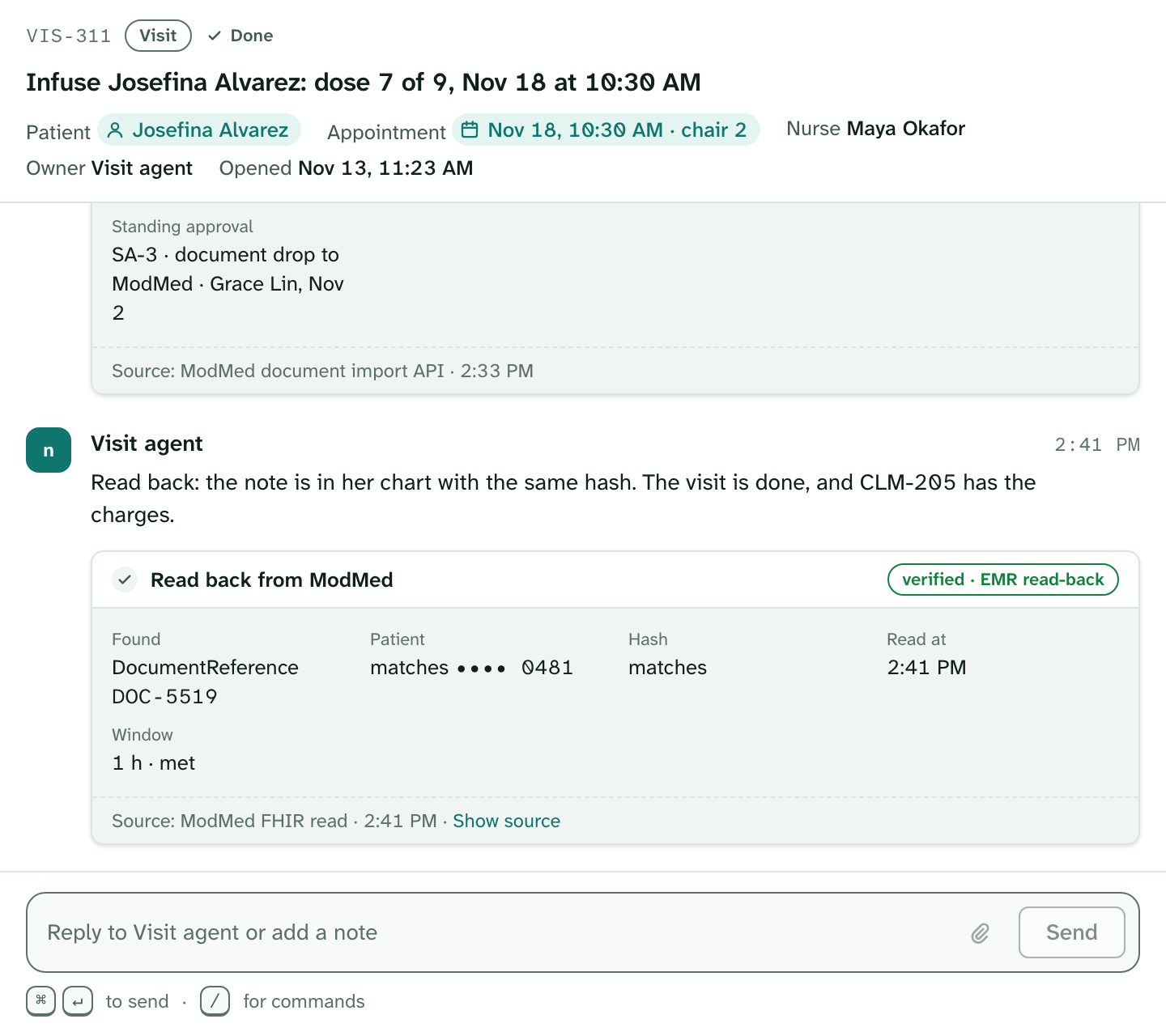
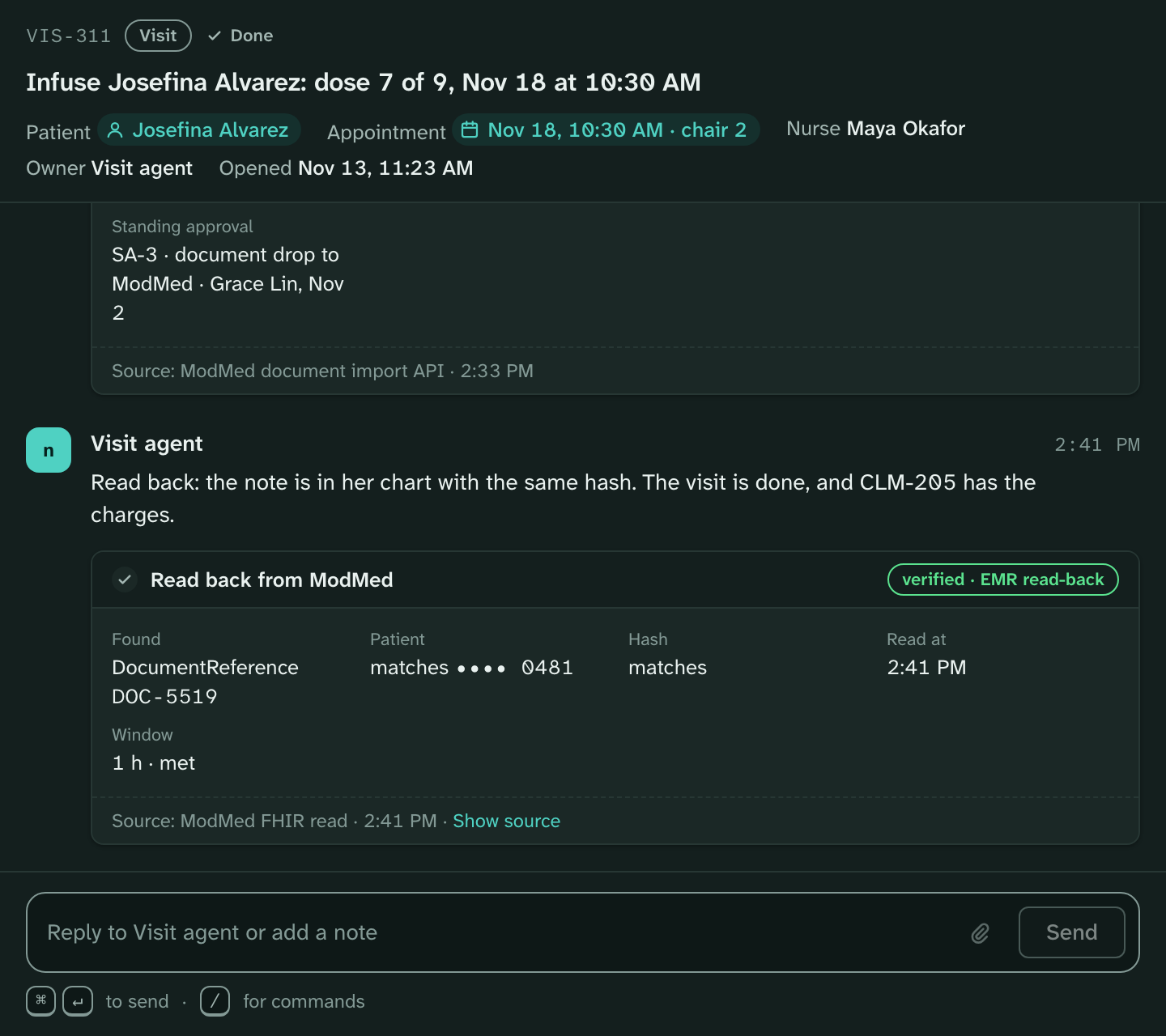
A note sent to the EMR is inferred until the agent reads the chart back. Then it is verified. The visit closes only then, so a document drop that silently failed never looks like a filed note.
What it stands on
What it stands on. No hand-waving.
- FHIR underneath.
- Clinical data is stored as FHIR, one store per center, checked against nico’s own rules on every write. We read your EMR over its certified FHIR API. Every copy carries the time it was read, and every write back is proved by reading the chart again.
- Security by construction.
- The clinical store has one client, nico, on a private network. Agents act as named principals with short-lived, scoped credentials, on behalf of a person. Every read of a record is audited. Anything clinical or financial passes a gate. A kill switch stops any agent at its next step. A patient’s full identifiers appear in one place.
- State of the art AI, kept honest.
- The best available models read the faxes and letters. Every fact they extract carries its page and its confidence. Nothing inferred reaches a payer or a chart without a person, and no model decides treatment or money. The payer-policy knowledge base learns from outcomes.
Pricing
Software that does not take a cut of every infusion.
An infusion center runs on thin margins. Drugs are bought up front. Payers pay late. Chairs have to stay full. If your software bill is a line per infusion, it grows with every patient you treat and penalizes you for growing your own business, while the work still lands on your staff.
Adding an AI tool on top of practice software means two bills and two systems to keep in step. nico is one system, built for agents and people from the first line, and one fee. Our terms are a commitment, not a quote.
- One flat monthly fee. Never per infusion.
- You pay for the software, monthly. That is the whole price. Treating more patients never raises the bill, and no part of the fee is tied to a dose.
- Monthly contracts only.
- No annual lock-in. You stay because the software works for you. You can leave the month it stops.
- You deal with the founders.
- The team is small and technical, and we plan to keep it that way. No salespeople to get through. The people you talk to are the people who build it.
Design partners pay nothing while we build it, and are offered equity.
Design partners
Built with a few infusion centers first.
Design partners are owners of smaller infusion suites who want a say in what nico becomes. They use each part as soon as it is safe to use, pay nothing while it is built, and are offered equity. nico is lean and self-funded: no VC, no PE, and nobody pushing us to raise the price.
FAQ
Plainly, where this stands.
Short answers to what a coordinator, a biller or a practice owner asks first.